Consumerism ?
We live in a
consumer oriented society; one based on needs and wants of consumers, but also
one whose needs and wants are a reflection of the market and new product
developments. The question whether consumerism is a result of marketers, or
producers satisfy people’s desires is a debate that has been discussed for
quite some time. In order to come as close as possible to the answer of that
question, one must be familiar with the basic concepts of consumerism and new
product development.
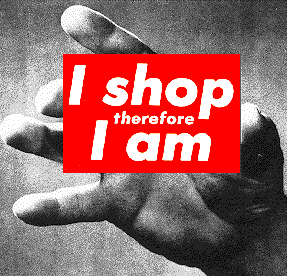
 What exactly is
consumerism and how does it affect society? It is an economic and social order
that encourages the purchases of goods and services in greater amounts. It
started in the late 17th century and emerged though the 18th
century. The biggest growth by that time could be seen in industries like glass
making and silk manufacturing. The aim of the time was making luxury goods
affordable for as many people as possible. Later on the availability of goods
was drastically changed by the Industrial revolution, creating an unusual
economic situation. Through the years evolved the term “conspicuous
consumerism.” It was created by Thorstein Veblen and it explains an irrational
form of economic behavior among people: “It is true of dress in even a higher
degree than of most other items of consumption, that people will undergo a very
considerable degree of privation in the comforts or the necessaries of life in
order to afford what is considered a decent amount of wasteful consumption; so
that it is by no means an uncommon occurrence, in an inclement climate, for
people to go ill clad in order to appear well dressed.” The core concept of 21st
century commercialism is emulation. It is a general trend regular consumer to
seek emulation to those who are above them in the social hierarchy. The poor
strive to imitate the wealthy and the wealthy on the other hand look up to
celebrities and other icons. This purchasing behavior may co-exist in the mind
of a consumer with an image of oneself as being an individualist. This is a
trend that is growing even faster with every new generation. Since the
beginning of consumerism many people have seeked for alternative lifestyle. It
is a wide range that starts from "simple living", goes through
"eco-conscious shopping" and "localvore"/"buying local",
and ends with the extreme Freeganism. Many critics define consumerism as the
tendency of people to identify themselves with specific luxury products and
brands that will define their social and individual status. This could lead to
such extends that consumers might sacrifice time, income and energy not only to purchase but also to actively
support a certain firm or brand.
What exactly is
consumerism and how does it affect society? It is an economic and social order
that encourages the purchases of goods and services in greater amounts. It
started in the late 17th century and emerged though the 18th
century. The biggest growth by that time could be seen in industries like glass
making and silk manufacturing. The aim of the time was making luxury goods
affordable for as many people as possible. Later on the availability of goods
was drastically changed by the Industrial revolution, creating an unusual
economic situation. Through the years evolved the term “conspicuous
consumerism.” It was created by Thorstein Veblen and it explains an irrational
form of economic behavior among people: “It is true of dress in even a higher
degree than of most other items of consumption, that people will undergo a very
considerable degree of privation in the comforts or the necessaries of life in
order to afford what is considered a decent amount of wasteful consumption; so
that it is by no means an uncommon occurrence, in an inclement climate, for
people to go ill clad in order to appear well dressed.” The core concept of 21st
century commercialism is emulation. It is a general trend regular consumer to
seek emulation to those who are above them in the social hierarchy. The poor
strive to imitate the wealthy and the wealthy on the other hand look up to
celebrities and other icons. This purchasing behavior may co-exist in the mind
of a consumer with an image of oneself as being an individualist. This is a
trend that is growing even faster with every new generation. Since the
beginning of consumerism many people have seeked for alternative lifestyle. It
is a wide range that starts from "simple living", goes through
"eco-conscious shopping" and "localvore"/"buying local",
and ends with the extreme Freeganism. Many critics define consumerism as the
tendency of people to identify themselves with specific luxury products and
brands that will define their social and individual status. This could lead to
such extends that consumers might sacrifice time, income and energy not only to purchase but also to actively
support a certain firm or brand.
No comments:
Post a Comment